Sitting in the bar of the Caledonian Sleeper train with my then twelve year old son Louis, it is hard not to people watch, wondering where everyone is heading on this early summer, late night train to the Highlands. One father tells his teenage daughter off for wearing headphones, shouting “For goodness sake, you are meant to be on an adventure, stop being such an unfriendly disgrace”. Louis and I suppress a giggle, but my insides tighten just a little, aware that he too is on that puberty precipice, and who knows where that will take us.
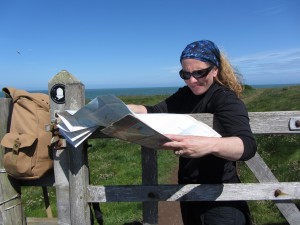
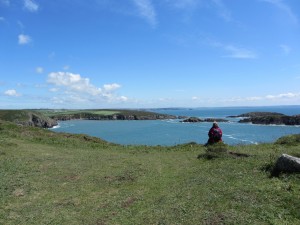
Catherine on Pembrokeshire Coast Path between Whitesands and St Justinian’s Bay
Driving through my native Ireland,I remember spotting a road sign in The Burren region of County Clare, with the words “Ah, will ye ever” painted above the word ‘Stop’. I often wondered if it was for the benefit of tourists who dash through en route to Connemara or Kerry, missing the National Park’s limestone wonders which gleam like the biggest emeralds of all. The Welsh ferry ports should have a similar sign for all those Irish people who dash off the ferry en route to England and beyond. Because, believe me, you really need to stop.
As I walked straight out of Fishguard onto the Pembrokeshire Coast Path, a spectacular 299 kms walking trail which snakes its way along this three for the price of one coastline, with craggy, sandy and rocky all on offer depending on which headland I traversed, it’s hard not to lament the lack of such a facility back home. This area is also the UK’s only coastal National Park which also incorporates a whole web of inland pathways, bridleways and estuaries
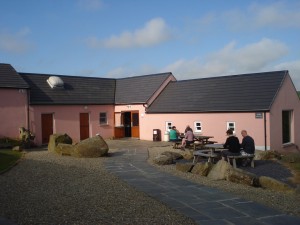
With just a few days to spare, I took on a few different sections of the Path. Staying at Preseli Venture Eco Lodge, a vibrant, family-run activity centre where I had first stayed a couple of years ago when I first explored the coast from the water that time, sea kayaking and coasteering. They welcome everyone here like long lost friends and celebrate Pembrokeshire’s wealth of natural heritage with such infectious enthusiasm that I thought this would be the perfect base for a bit of solitary walking this time. And as part of their Self Guided Walking Break, they also serve vats of wonderful home cooked food all day, so I hit the roads with a belly full of breakfast, a packed lunch, in the knowledge that a big curry or casserole was waiting for me each night.
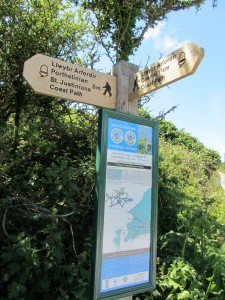
Walk and bus the coast path in Pembrokeshire and all around the Welsh Coast
Preseli is located 11 kms from Fishguard, where the owners will pick you up if they can although it is a quick cab or bus ride if you are coming by foot. And I really recommend leaving the car behind. It’s much cheaper, you really slow down and there is a brilliant all year round tourist bus service to get you to and from the favourite spots and which you can hail at any spot along its route. For more details and timetables see walkingpembrokeshire.co.uk.
On the first afternoon, I shook off my journey jaundice by fitting in a three hour walk along the coast Path from nearby Aber Mawr beach heading south to Trefin, where I caught the bus back to the campsite. The weather was drizzly enough to get my walking boots suitably muddy and my new waterproof trousers tried and tested. However, in spring this whole coastline erupts into colour with pink Foxgloves, white Ox-eye Daisies, blankets of yellow Kidney Vetch and Wild Primrose dotted with the purples of wild thyme, uplifting the spirit no matter what the weather is doing.
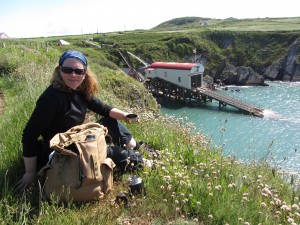
The sky was cloudless on day two, however, when I started out on my 19 kms circular, and nearly all coastal, route around St. David’s which, although it is the smallest city in the UK, has one of the largest collection of coves and cliffs on its doorstep, most of which are only accessible by foot. I took the bus again to St. David’s, where the cathedral clock struck nine as I headed up a long, narrow road where the grass still grows in the middle, to the expanses of Whitesands Bay. Heading south again, the Coast Path overlooks Ramsay Island , a bird reserve and favourite hangout for seals, dolphins and porpoises (ramseyisland.co.uk) although, as I dipped in and out of tiny uninhabited bays, I only spotted a few cliff climbers, kayakers and a couple of fishing boats. It never gets busy here really, except around the historical honeypots of St Justinian’s Bay, with its ancient chapel and a stunning red and cream lifeboat station with funicular system designed to transport people and good up and down the cliff, or the turquoise inlet of Porth Clais with its ancient lime kilns built into the harbour walls (and a much needed coffee and ice cream kiosk).
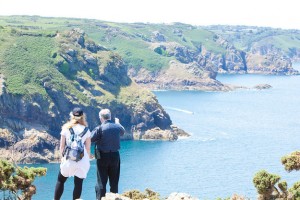
Catherine overlooking the lifeboat station and funicular at St Justinian’s Bay, on the Pembrokeshire Coast Path
The only other company en route was the odd smiling hiker pursued by some of the choughs, cormorants and stonechats which favour this stretch of coast. Not surprising, therefore, that the retreat at St Non’s is still used as such, with yoga, meditation and religious retreats all part of the mix (stnonsretreat.org.uk). This was the birthplace of St. David, Non being his mother, and I must admit that even though I popped into the chapel in search of shade rather than spirituality, I found this a moving place indeed.
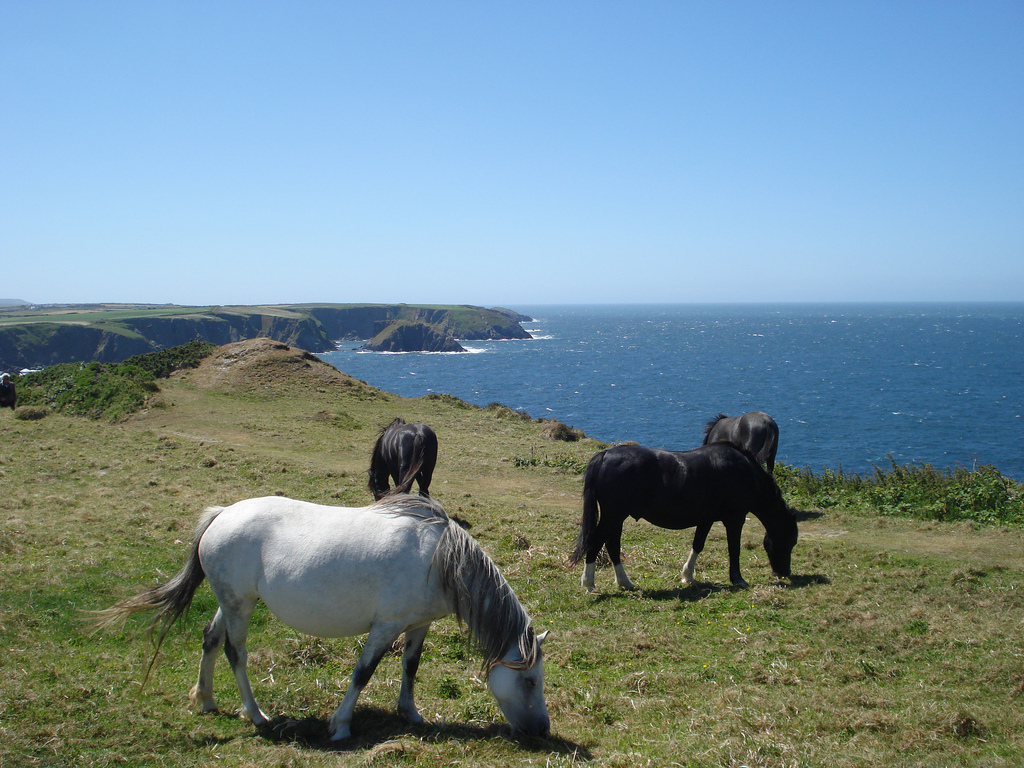
My last day of walking took me around Strumble Head, just 5 kms from Fishguard, where wild ponies are let out to pasture in order to keep these remote rocky slopes and paths clear of bracken and gorse, and where an imposing white lighthouse issues warnings to the incoming ferries. This is where I realised that I really didn’t want to leave this Path at all now. I had become a headland addict, wanting ‘just one more’ before giving up. However, there are plenty more fixes to be had now as, following on from Pembrokeshire’s success, all 1400 kms of the country’s coast were officially opened to walkers in May of this year, known as the Wales Coast Path. So now walkers don’t have to stop at all, they can just keep going and going.
Go there:
Ferry Rosslare to Fishguard with Stena Line, Tel: 01 204 7777, Foot passenger between
Preseli Venture Eco Lodge – eco friendly and super friendly all round
Rosslare to Fishguard €32 one way, or bring your bike for €10 one way. For more information on their excellent rural bus schemes linking the Pembrokeshire Coast, see walkingpembrokeshire.co.uk or visitpembrokeshire.com.
Catherine stayed at Preseli Venture Ecolodge and Activity Centre (preseliventure.co.uk, Tel: +44 1348 837709) open to individuals mid-week for Sterling £39 pn b&b, or £59 pn fully catered. Or check out their self guided walking holiday which is aimed at hikers doing their own thing. Take a break from hiking and explore the Coast from the water on one of their activities, from £55. Coasteering is a must.
We alI love the choice of words that Ron Mader, editor of Planeta.com, has used to guide us through this year’s Responsible Tourism Week, an online conference which was created by Ron himself. Every day he used a new theme, teaching us to be Attentive, Generous, Creative, Empathetic, Curious and Grateful while immersing ourselves in the world of travel, whether we are hosts, guests, writers, photographers, publishers, tourist boards, activity providers etc.
I am always bowled over by the personalities I meet on my travel writing expeditions. They demonstrate the practice of these key words throughout every aspect of their businesses and so I am taking this opportunity to celebrate them. Please visit their websites, follow them on Twitter or Facebook, spread the word about them, and use them as case studies to inspire others to act the same way. Or, if they have businesses which are open to guests, just go visit them. They will all be glad to say hi, I am sure.
Attentive – One of the most attentive people I know is Valere Tjolle, a UK based sustainable tourism consultant with Totem Tourism and Sustainable Travel editor at Travelmole. Anyone who has been lucky enough to meet and chat with Valere in detail about the issues of sustainable tourism will know that there are few more attentive people than him. He talks and writes about sustainable tourism in a way that steers clear of academic bluff, he has no hidden agendas, he has been working in tourism for long enough to see responsible tourism go from niche to norm, back to niche and then to a place which lies strangely in between the two. When hearing about worldwide tourism projects he is attentive to all the details, highlights them on Travelmole for all of us to read. He listens to everyone’s stories, asks all the right questions and pushes the envelope when questioning tourism leaders. His attentiveness means that many people, who wouldn’t normally be given one, have a voice. He has also decided to extend his already busy life into a tour operator business, just launched this week, bringing tourists to the wonderfully undiscovered region of Romagna in Italy . Still in its infancy, Watch this space , Best of Romagna, for more details.
Pembrokeshire coat path between St justinian’s bay and Porth Clais
Generous –Having walked on The Wales Coast Path a lot, one of the most glorious long distance walking routes in UK, I was struck by the generosity of landowners who are happy to share their space with tourists. I stood on the Pembrokeshire coast after walking from headland to headland all day, looked out across the water and thought how amazing it would be to walk the whole coast of my native Ireland. But sadly it isn’t possible, due to land access issues. This is the same in so many countries, but in Wales farmers and other land owners have opened up paths for walkers, albeit in exchange for a small remuneration, meaning that not only can you now walk the length of the coast of Wales, but around the whole country as the Coast Path now links up with the Offa’s Dyke Long Distance Trail which follows the inland border with England route for 285kms. All thanks to the generosity of strangers.
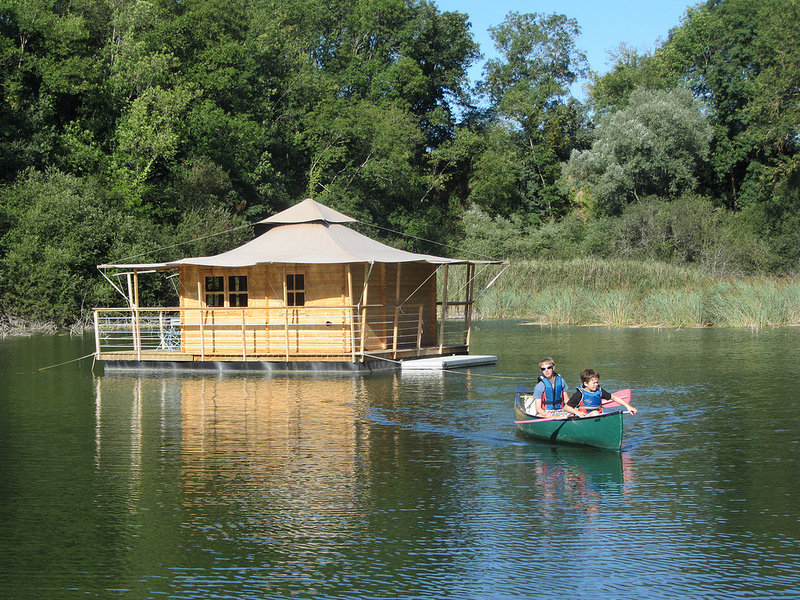
Catherine’s canoeing out to their beds at Echologia
Creative – This is a tough one as creativity oozes from every project I visit, but I think Echologia in the Mayenne region of France wins my creative prize this year.Apart from their website, that is, which has a way to go, but I forgive them as they have put all their creative energy into their stupendous eco set up. The proper name is actually EcH20logia, because this extraordinary 70 hectare site revolves around water, ecology and lodgings, with three disused limestone quarries offering natural gems of a getaway now that their underground water sources have been allowed to seep back up to the brim again. Poised in and around these teal coloured water holes are a collection of twenty different places to stay, from yurts spread across a wild meadow, tipis within diving distance of the natural reed filtered swimming pool, cabins poised among the trees which overhang the waters or two cabins which float serenely in the middle of one of the basins. And all the creative vision of a group of local men and women who wanted to bring this dead space back to life again. Their vision is Zen like, but not in a purist, whispering way. It’s just about chilling in nature really and their act of replacing a loud, industrial space with something so natural is worthy of praise.
Empathetic- This is a tough one, but when I get a room full of food producers and tourism providers who just thrive on local sourcing, I really start to feel the love. Connecting tourism with local producers is when responsible and ethical tourism starts to kick ass. There are so many tourism businesses which go the extra mile to ensure that they source their food locally, totally empathising with the farmer down the road and working hand in hand to create the most deliciously local experience. In Ireland, John and Sally McKenna’s Guidebooks , Best Restaurants and Best Places to Stay not only capture all the flagships of local produce in Ireland, but are written with total empathy and love for everyone mentioned in the book. Organic Places to Stay website has a wonderful selection of places to stay all around the world, which use organic and local produce. I am totally in love with the small island site, Real Island Foods on the Isle of Wight just off the South coast of England, where you can order all your local produce before you arrive, so that it is waiting at your self-catering accommodation when you arrive. Surely a model to emulate in other small destinations? Other websites in the UK which promote the food of love include farmison.com which has a plethora of farm to fork food and bigbarn.co.uk which is a great short cut to finding local producers on your travels. Just enter a postcode to find your nearest market, farm shop, artisan producer etc. Please feel free to comment on this below if you have found similar food tourism networks around the world, so that I can spread the word, and provide the ultimate feast of tourist sites with local food at
John and Sally McKenna’s Guidebooks to Ireland
their core
Curious – Well, I guess I have to come back to travel writers for this one. The people who love to dig and delve, but who also put responsible tourism at the heart of their work. Twitter has been a wonderful way for all of us to communicate and share ideas, and so here is a shout out to some of my favourites. Gail Simmons (@travelscribe) writes about the Middle East with great wisdom and sensitivity and has been Highly Commended at the Virgin Holidays Responsible Tourism Awards twice. She has introduced me to the wonders of Palestine and the exciting tourism developments happening at The Siraj Centre . Caroline Eden (@edentravels) works a lot in Asia and was also Highly Commended at the Virgin Holidays Responsible Tourism Awards 2012. Matthew Teller is also rather brilliant on the Middle East, and is a wonderful commentator on Twitter too. Kevin Rushby is The Explorer for The Guardian newspaper and he is, basically, just too cool for school and I am at my greenest when reading his work….with envy that is! Richard Hammond of the UK’s Green Traveller website wrote the green travel column in The Guardian for years and then went on to found his website, which features hundreds of green holiday ideas all of which are accessible by train. He also has a writers’ blog on his site which he contributes to regularly as well as a team of other writers. Such as Paul Miles who lives on a houseboat and so no better man for writing about slow travel and slow living (@Travel_n_green), Rhiannon Batten – the author of Higher Ground: How to travel responsibly without roughing it, and also regular feature writer for The Guardian and The Independent in UK (@rhiannonbatten), and Jeremy Smith who is former editor of The Ecologist magazine and starting to write a lot about wildlife conservation via his blog Fair Game and on Twitter @jmcsmith.
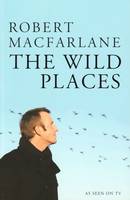
The Wild Places by Robert MacFarlane
Jini Reddy is one travel writer I would love to travel and work with one day. She just seems to sing from the same songsheet as me, as you can see just from her trip portfolio, which includes a canoe trip along Botswana’s Selinda Spillway and taking tea with the women of Pakistan’s pagan Kalash tribe (@Jini_Reddy). And last, but not least, Leo Hickman, environment editor for The Guardian newspaper in the UK, who also wrote the wonderful book on responsible tourism – The Final Call. He is also very active on Twitter, so follow and fall in awe, like I do every time I read his fine pieces of journalism, such as this recent one on flying and climate change. And to conclude, the Saint of all travel scribes, Robert Macfarlane , whose books seem to glow on my bookshelves telling me to pick them up and read them again and again. If you haven’t treated yourself already, check out the ever curious compositions of this extraordinary travel writer in The Old Ways: A Journey on Foot (2012), The Wild Places (2008) and Mountains of the Mind: A History of a Fascination (2003)
Catherine, totally grateful to be walking in Jersey
Grateful –Well, asI get to share Tweets, cross paths and go on journeys with nearly all the above, who else could be more grateful than me, of course?
With thanks to Ron Mader and all the participants of #rtweek2013 and #rtyear2013, as well as all my fellow travellers.
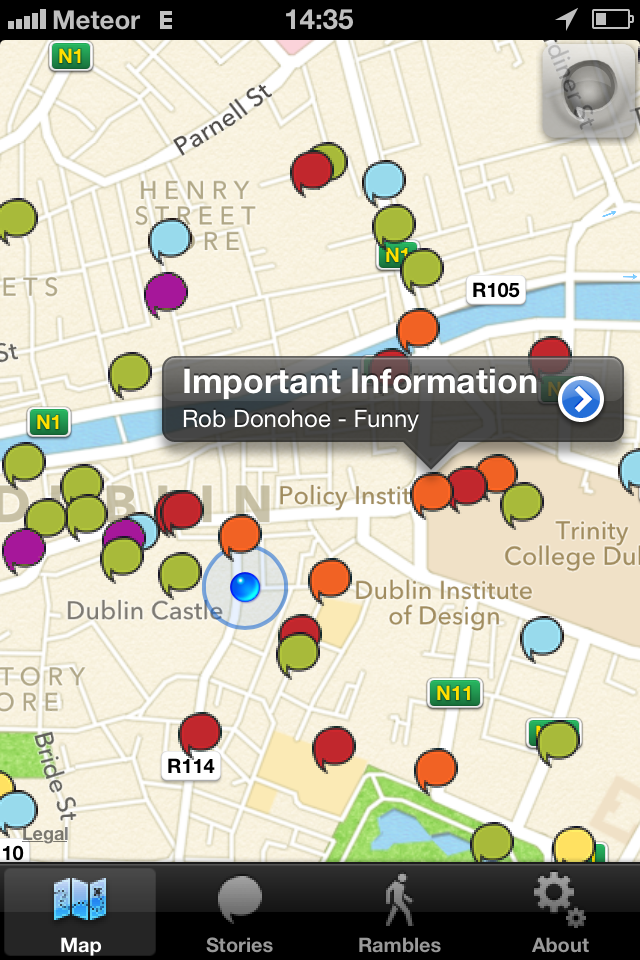
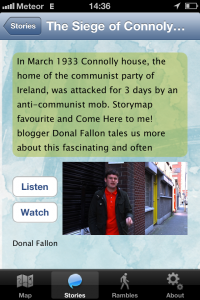
A new and completely unique way to explore the city was unveiled today, with the launch of the Storymap App, which lets users tap into the hidden stories of Dublin as they wander around its streets. The app rejuvenates the age old tradition of storytelling – combining it with the latest technology in film and mobile apps to capture the essence of Dublin life, past and present. Included in the app is a huge library of 80 stories, presented in crisp audio or HD video, each tied to a location in the city and told by a different Dubliner, all with their own unique voices. This opening collection will grow by 4 stories a month, as the Storymap continues expanding.
“For a local, it gives them a chance to see the city with fresh eyes” explains co-founder Tom Rowley “Walking around Dublin I always used to wonder ‘What happened here?’ and the app gives you the answers – you’re walking on layer upon layer of fascinating stories, both personal and historical. On O’Connell Street alone there are riots, risings, nervous dates, and hoax plaques – along with hundreds more we’ve yet to capture. By using the app and seeing a well-told story on the spot, you get to see it in a whole new light, and build a new connection with it”.
The app is the product of two years’ work tracking down the finest stories and storytellers of the city and capturing them on film. Tom Rowley and Andrew Flaherty first launched the project in 2011, with the website Storymap.ie, which showcases the stories online. The project was, in many ways, a reaction to the gloomy mood hanging over Dublin.
‘We both arrived back from working abroad and were really frustrated with the way the city was being represented – bleak, empty and finished’ says Flaherty ‘For us, the things that made Dublin truly special were still there to be celebrated – its people, its stories, its humour and charm. We couldn’t find work and so we began Storymap as a way to use our skills to showcase the real cultural wealth of Dublin, in a way no-one had ever seen before. The support we got from people amazed us – writers, historians, artists, actors, barmen – all gave us their time, their stories, and their support to build this ’.
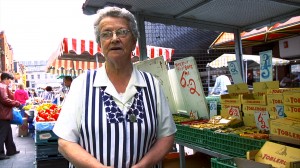
The wonderful Bernie who has been working on Dublin’s Moore Street market since she was seventeen
As well as presenting the stories mapped to location for the user to discover, the App includes a series of incredible innovations.
• Rambles: The stories are collected in eight themed routes across the city, each offering a different flavour of the city’s life and history. It’s the equivalent of eight walking tours in your pocket.
• The App also has the ability to generate a ‘ramble’ based on any destination and so transform a simple walk across the city into an engaging and entertaining experience.(For example, if you’re on Henry Street and have to meet someone at the Guinness Storehouse, you can simply tap in your destination and a ramble will be generated which links stories along your route).
The stories on offer are just as diverse as the storytellers. An exclusive story from Roddy Doyle skillfully brings to life a girl’s anxious wait at The Spire in a wonderfully evocative tale. Doyle said of working with Storymap “I loved the experience, seeing how Storymap took my words – all 155 of them – and, almost literally, built part of O’Connell Street with them. It was clever and moving and, as I watched, I felt proud – and very grateful.”
There is a treasure trove of historical oddities – from the massive explosion on Wood Quay that killed off one per cent of the population of Dublin to the French gangs of the 18th century, The Liberty Boys, whose violent feud with The Ormond Boys often brought the city to a standstill.
Old memories of Dublin and its characters abound, and the most popular story features two Dublin gents, The O’Neill brothers, recounting their lives and loves in Fallons bar, ending in an impromptu song. The cartoonist Tom Matthews regales the viewer with an hilarious account of his lifelong love of the ‘Why Go Bald?’ sign, and how it’s served him down the years. Comedians, artists, musicians, poets and writers all add to this kaleidoscope of Dublin life, which constantly surprises and entertains.
The App was developed at the Dublin Institute of Technology by Jamie Osler and Eoin Rogers, and overseen by Bryan Duggan. It is on sale in the Android and iPhone app stores for €2.59. Using their fanbase in Dublin, Storymap crowdfunded the initial funds through the innovative funding website fundit.ie, and then supplemented this with funding from Enterprise Ireland. The resulting App is an invaluable resource for Dubliners who want to explore their city in new ways, and also for tourists hoping to have a genuine and authentically local experience of Dublin. It is also great fun, and will bring a smile to anyone who uses it.
“A lot of the times when you’re traveling as a tourist, it can feel like you’re on the ‘wrong side of the glass’ and not able to access the real life and culture of the city’ explains Rowley “And with our app we wanted to provide a tool that would let a visitor to Dublin to feel a real connection with the city through its people and stories. Tourism research shows a huge desire from modern tourists for an experience that’s authentic, unique and where they have the freedom to explore the city through their own tastes and interests. With the Storymap app we’ve created the ideal product for this new type of tourist.”
The App launch is the start of a busy year for Storymap, with a number of plans for expanding in Dublin and to new cities internationally. Storymap are currently collaborating with Dublin UNESCO City of Literature to build a version of Storymap tailored to showcase the city’s literary heritage in a unique App and website, while they’re also planning to build a Storymap specific to the Dubline, a new walking trail concept,in collaboration with Failte Ireland. With interest from abroad the two filmmakers are aiming to bring the project to new cities, including London, Galway and Derry in the coming year, with further plans to establish the Storymap concept across Europe as a unique and innovative way to engage with a city.
For more information see a short video here and for a quick treat of a clip of the wonderful Bernie mentioned up above, see below