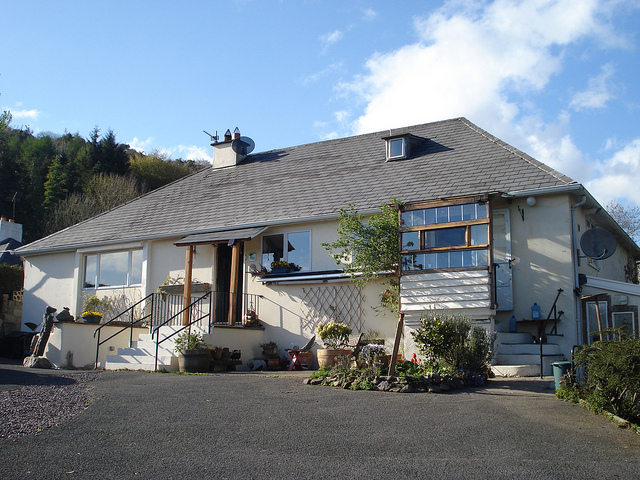
Glenribbeen b&b in County Waterford, Ireland

Glenribbeen Eco Lodge, Waterford, Ireland. Photo: Catherine Mack

There are some people who like to hide their green beliefs under a bushel and then there are those who stick a great big flag in their garden to let the world know that being green is no mean feat these days, and so if you’ve got it, you might as well flaunt it. Glenribbeen Eco Lodge is a small bed and breakfast run by Els and Peter O’Connor which has greenness and kindness oozing from every open pore. I say open, because the doors of Glenribbeen are always open. If you turn up with your tent they’ll welcome you, with dogs, children, a horse, whatever, they would turn few away. Because Irish Peter and Dutch Els’ approach to hospitality and life are holistic and generous. They are both musicians and artists, growers and creators within the community, and the guesthouse is all part and parcel of that.

The flag is that of the EU Flower, the eco certification which Peter and Els were awarded in 2009, and with solar panels, rainwater harvesting, home made briquettes for the fire, fine organic vegetarian food, bat boxes, free range hens happily pecking around the beautiful gardens and bird feeders at every turn, they have merited the accolade for sure.

However, it is individual dedication, imagination and understanding of the bigger picture of responsible tourism which makes a business truly sustainable, not just the solar panels or light bulbs. You can stick as many responsible tourism policies as you like on your website, or boast about all your eco-gadgets, but it’s the living and breathing it, having a real connection with how their tourism venture can be part of a wider green community, that makes somewhere like Glenribbeen so special. Just have a quick look at Peter’s blog to see everything from a broad bean hummus recipe to creating a solar powered walkway in your garden, and this will give you an idea of his commitment to all he believes in.

This is not an eco-chic home, however,  it is just a home built on sustainable, simple principles, with balconies made from recycled wood, vegetable gardens, books from second hand shops, a living room full of musical instruments. It’s a place where Els’ beautiful paintings cover many of the walls and where Peter shares his passion of archery with his guests by offering lessons free of charge. They know the nearby walking and cycling routes like the back of their hands, with extremely quiet trails straight out of their garden gate, taking you as far as The Vee Gap and the Knockmealdown Mountains.  Or the O’Connors will arrange hired bikes to be delivered to the house from Lismore Cycling Holidays, with convenient off road cycling into Lismore town and then into the hills beyond.

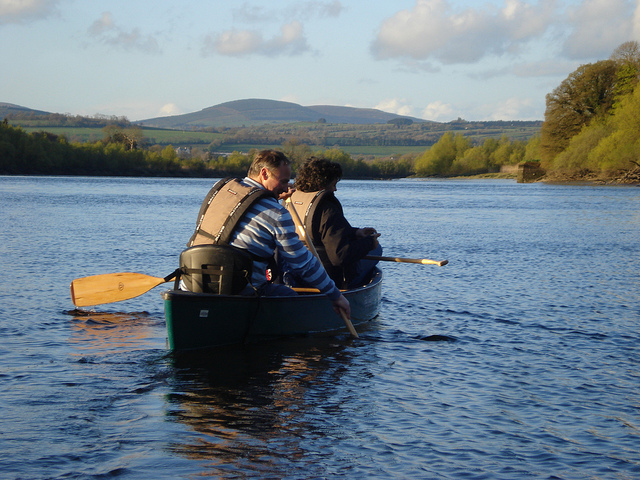
We decided to explore the area from the water, however, and thanks to a top tip from Peter, also a keen canoeist, we spent a few hours of a sunny late afternoon in the delightful company of Cappoquin man, Dennis Murray of Blackwater Boating who, having spent his life on the river, knows every bend, bridge and building on it. His gentle charm and local knowledge of not only the flora and fauna, but every historic building which overlooks the river, was enrapturing, regaling us with history one second, and heron spotting the next.  With so much attention given to Waterford’s fine beaches, we were amazed to see that this haven of river life was almost deserted.
Another wonderful facility on their doorstep is the wheelchair-friendly fishing boat, the Wheelyboat of which Peter is one of the registered captains. With fingers in many pies, a new project always on the go, Peter definitely has a ‘glass half full’ approach to life and, as we said our goodbyes, he gave us a stick of rosemary to put on the dashboard to bring energy to the driver and natural perfume for the passengers, and Els popped a parcel full of her specialty Dutch pancakes on the kids’ laps for the journey. So, if you are looking for a place to stay in the Waterford area, owned by people to whom both generosity and green living come naturally, just follow the flag.

An edited version of this article was first published in The Irish Times in August 2011


Jersey’s cream has turned green

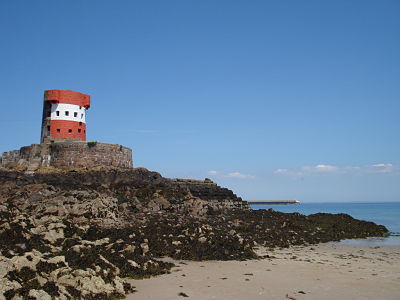
Archirondel Tower St Catherines Bay. One of several sustainable accommodations Photo: Catherine Mack

I remember Jersey as the first place I tasted a cherry. About five years old, I picked it off a tree and ate it, revelling not only in its unique perfume and texture but also in the fact that there were endless sweet gems for the picking. What felt like an ordinary family holiday had, in one moment, been transformed into an exotic adventure, an image of Jersey which has always stayed with me.

I didn’t go in search of cherries on a recent trip back to the largest of the Channel Islands, but I was aware of this same sense of excitement as I packed. I was there to explore the greener side of the island, to see if it is possible to discover it without a car – slow down the pace by walking, cycling and taking the bus around an island where, traditionally, local transport means a luxury yacht, private jet or a Bergerac-mobile.

It felt as if the bus service is made for tourists here, however, with drivers going out of their way to smile and proffer information. A family bus pass is £16.15 sterling per day which gets you around what local people fondly refer to as ‘The Rock’s’  74 square kilometres. My first stop on the number 1 bus was, aptly, Green Island, just a few kilometres east of St Helier, the island’s main, in fact only, town. A peninsula rather than an island, it has white sand and crystalline waters, and the perfect beach café serving locally caught seafood.

After a wake me up swim had done just the job, I got back on the Number 1 which clings to the shore as far as Gorey, a pretty fishing village on the East coast, and walked back along the dusty pink coast path built into the rosy granite which links the island geologically to its neighbouring Brittany, just 22 kms away.

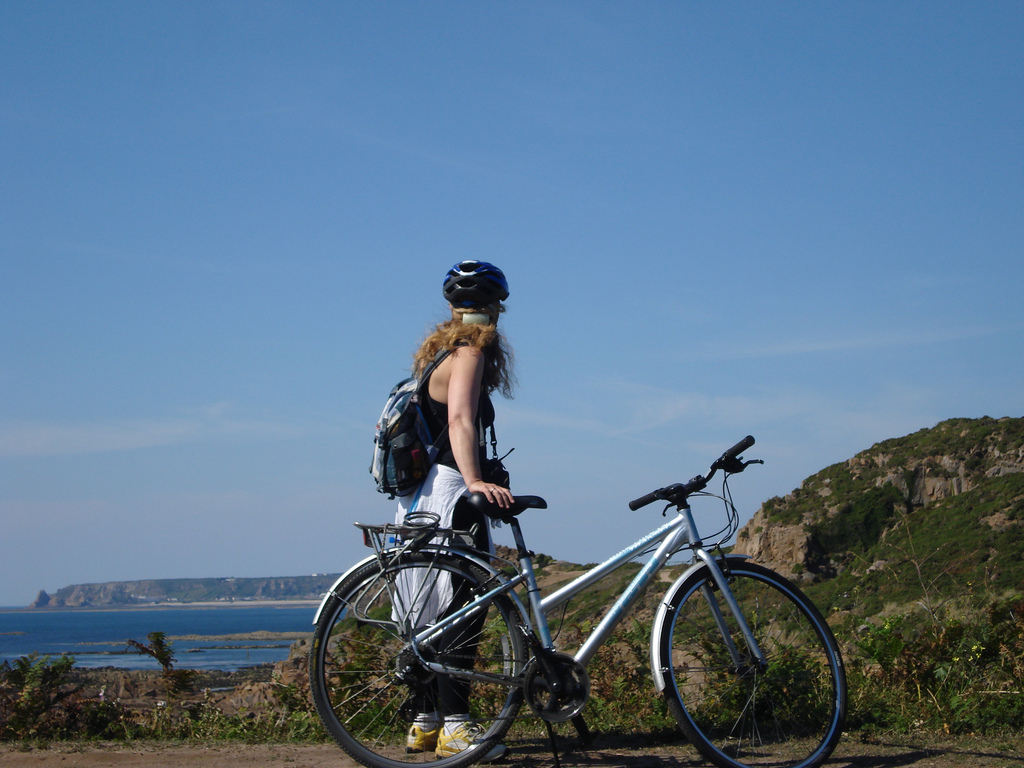
Catherine cycling between Corbiere and St Ouen, Jersey

With fine local produce just about everywhere I visited, I realised that this is obviously an island which values its local produce, and with Jersey Royals spuds, Jersey cows, a plethora of fish swimming off its shores, they have everything going for them here. Some of the flavours I can almost still taste as I write include a fresh crab sandwich at the Driftwood Café immediately after a swim in St. Catherine’s Bay; sipping local wine and test chocolates at the islands winery, La Mare Wine Estate, run on a committed green basis by a Cork man, funnily enough; buying picnic ingredients at the Victorian covered Central Market in St. Helier, and the superb ice cream at the Classic Herd Farm Shop in St. Peter’s Village, which has all the supplies you could want if you are self-catering.

The ice cream moment followed a long day of cycling along Jersey’s greatest green coup – the Green Lanes. Launched in 1987, this is an 80kms network of country roads where the speed limit is 15mph (24kph) and where walkers, cyclists and horse riders are given priority.  All clearly marked on road maps as well as by very visible signs on the lanes themselves, drivers also seem to respect the spirit of what Jersey is trying to achieve here. Cycling up lavender lined paths, past flower filled gardens and potato-filled fields, cyclists and walkers all greeted each other, most of us visitors who are new to the notion that, for once, we had right of way over cars.

For green places to stay you can choose between yurts overlooking St. Aubin Bay (jerseyyurts.com), one of several historic forts right on the sea from jerseyheritage.org, a courtyard apartment attached to one of the island’s most sumptuous manors and gardens in St. Clement (samaresmanor.com) or in converted officers’ quarters attached to an early 18th century military barracks metres from the sea at Grève de Lecq Bay (nationaltrustjersey.org.je). Wherever you stay, you will soon see there are beaches and coves at the end of almost every cycle, bus or walking route here. In fact, it’s worth having a couple of sets of togs tucked in your backpack, and more than a couple of days on the ‘Rock’ where there are so many cherries for the picking, their bowl runneth over.

St. Aubin Bay, Jersey Photo: Catherine Mack

An edited version of this article was first published in The Irish Times in August 2011. For more information on Jersey see www.jersey.com.


Don’t let child abuse travel

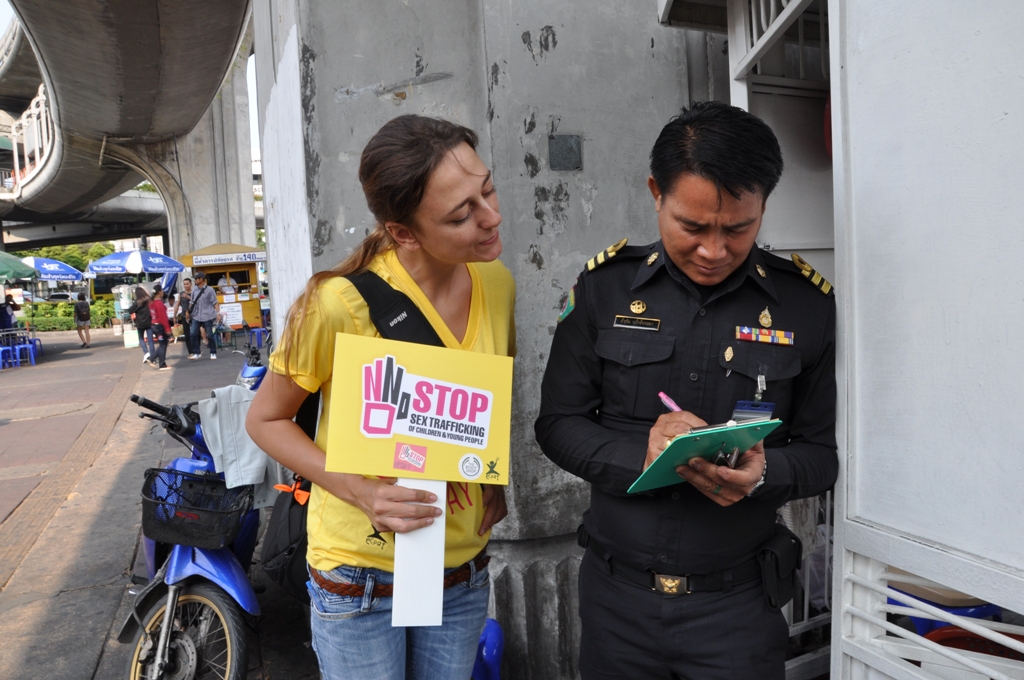
Thai Police signing ECPAT's and The Body Shop's 'Stop Sex Trafficking of Children and Young People' campaign petition Credit: ECPAT International

Most of us know that tourism is one of the biggest industries in the world.  However, travelling with the sole purpose of paying money for sex is also a form of tourism, and a multi-million dollar side of the industry it is too. And although these are not the type of economic benefits the world tourism industry boasts about as it develops across the globe, all sectors are set to benefit from it indirectly, including travel agents, hotels, airlines and taxis.

Less well known, however, is that over three million children are exploited for sex around the world. It was not surprising, therefore, that it was one of the topics being debated at last week’s United Nations World Tourism Organisation’s (UNWTO) International Congress on Ethics and Tourism in Madrid, which I attended along with 450 people working in tourism. One of the key speakers was Kathleen Speake, Executive Director of ECPAT International (ecpat.net), a global network of organisations and individuals working together for the elimination of child prostitution, child pornography and the trafficking of children for sexual purposes. Speake not only managed to astound us with her stats and strategies, but also enlisted many of Spain’s leading tourism companies to sign ECPAT’s Code of Conduct for the Protection of Children from Sexual Exploitation in Travel and Tourism, an initiative funded by UNICEF and supported by the UNWTO.

The Code (www.thecode.org) is for companies which are willing to put ethics before profits and already has 1030 signatories in 42 countries. ECPAT is not just about Codes and empty words however. They run international campaigns, lobby local governments to increase policing and change policy and  lead training groups for hotel and other tourism related businesses around the world.

ECPAT’s influence has been significant. In Thailand, for example, there have been more and more prosecutions relating to child sex tourism offences. But it is still happening, and although many prostitutes will claim to be over eighteen, few sex tourists are going to ask for ID. The town of Pattaya, for example, is notorious for prostitution, and you only have to put ‘bachelor holidays Thailand’ into Google or Tripadvisor see that the industry is thriving. In Leo Hickman’s book The Final Call (Eden Project Books, 2008) a serious piece of investigative journalism into the dark sides of tourism, he describes a visit to Pattaya where he saw “men sitting around tables with boys who look as young as ten…it seems gut wrenchingly obvious what must be going on”. They are rarely caught in the act of paying for or having sex with a child, however, as they groom the children in these cafes, and then have them ‘delivered’ at a later stage to their room. As Hickman puts it, “this is child abuse made as easy as ordering a pizza’.

And yet Pattaya, is a town which marketing website gothailand.com promotes as “The ideal family holiday destination” in one paragraph, and a place where “Beer bars and g o-g o bars are dotted all along main roads and side ‘sois’ (streets), and have earned a dubious reputation for Pattaya, but also happens to be one of the main draw-cards” in the next. Thailand is not alone, of course, with ECPAT providing statistics on many countries around the world, such as Mexico’s 20,000 minors being estimated to be victims of prostitution, Kenya claiming to have as many as 30,000 girls aged from 12 to 14 being sexually exploited in hotels and private villas, and Moscow alone thought to have between 20,000 to 30,000 victimised children.

According to ECPAT, the majority of people exploiting children for sex purposes are not all defined as a ‘paedophile’ either, but more often as a ‘Situational Child Sex Tourist’, i.e. “someone who abuses children by way of experimentation or through the anonymity and impunity afforded by being a tourist. He or she does not have an exclusive sexual inclination for children”.

So, what can we do? Support ECPAT through donations, but also check www.thecode.org to see which companies have signed up and, more significantly perhaps, which ones haven’t. Accor Hotels (which includes Novotel, Mercure, Ibis and Sofitel) have worked with ECPAT for eleven years now, for example. If your hotel, airline, tour operator or travel agency has not signed up, then ask them why not. And most importantly, as confirmed by ECPAT’s website, report anything suspicious directly to them as well to a local authority if you can. This includes if you see a tourist sexually abusing a child, a person selling a child’s services (including a taxi driver, waiter, café owner etc), a tourist trying to buy a child for sexual exploitation and a hotel or travel company allowing it to take place. Child abuse has shocked us for many years at home, but now the time has come to ensure that we don’t let it travel.

An edited version of this article was published in The Irish Times, September 2011


Canopy and (five) stars

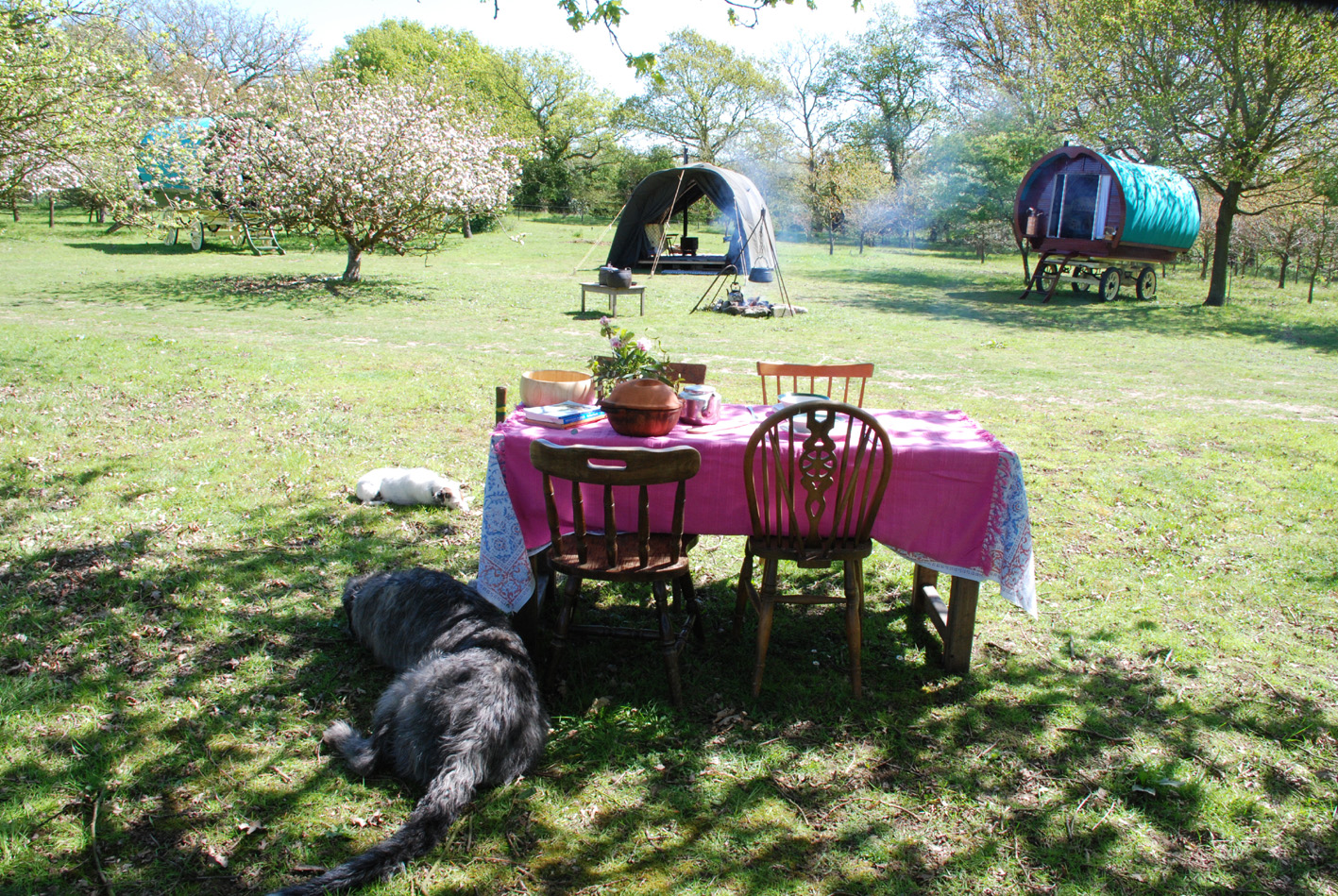
The Gypsy Camp, Essex Photo: Canopy and Stars

You know that feeling when you first open a box of Green and Black’s chocolates? Butterscotch is better than…Ok, let’s not go there. Well, when I first went on Canopy and Stars website, it had the same impact really. Each web page unwrapped a delicious, quirky place to stay,and  the choice almost overwhelming. Which is why I have invited them to write a guest blog, featuring places which are all accessible by public transport of one sort or another. I am all for leaving the car at home, so hopefully these places will inspire you to do the same. And after all those chocolates, it is best for me to get walking, cycling, canoeing there anyway. Over to the gang who created it…

Canopy and Stars.


“Holidays are great. Getting there… less so. If you’re lucky, you’ll get to stop at the M&S at the service station. You might even have a really good mix CD…

But it doesn’t have to be like that! Canopy & Stars, the leading new glamping company, is encouraging you to leave the car at home, and make your journey part of the fun! To get you started, here is a selection of unusual places that can be reached by unusual means…

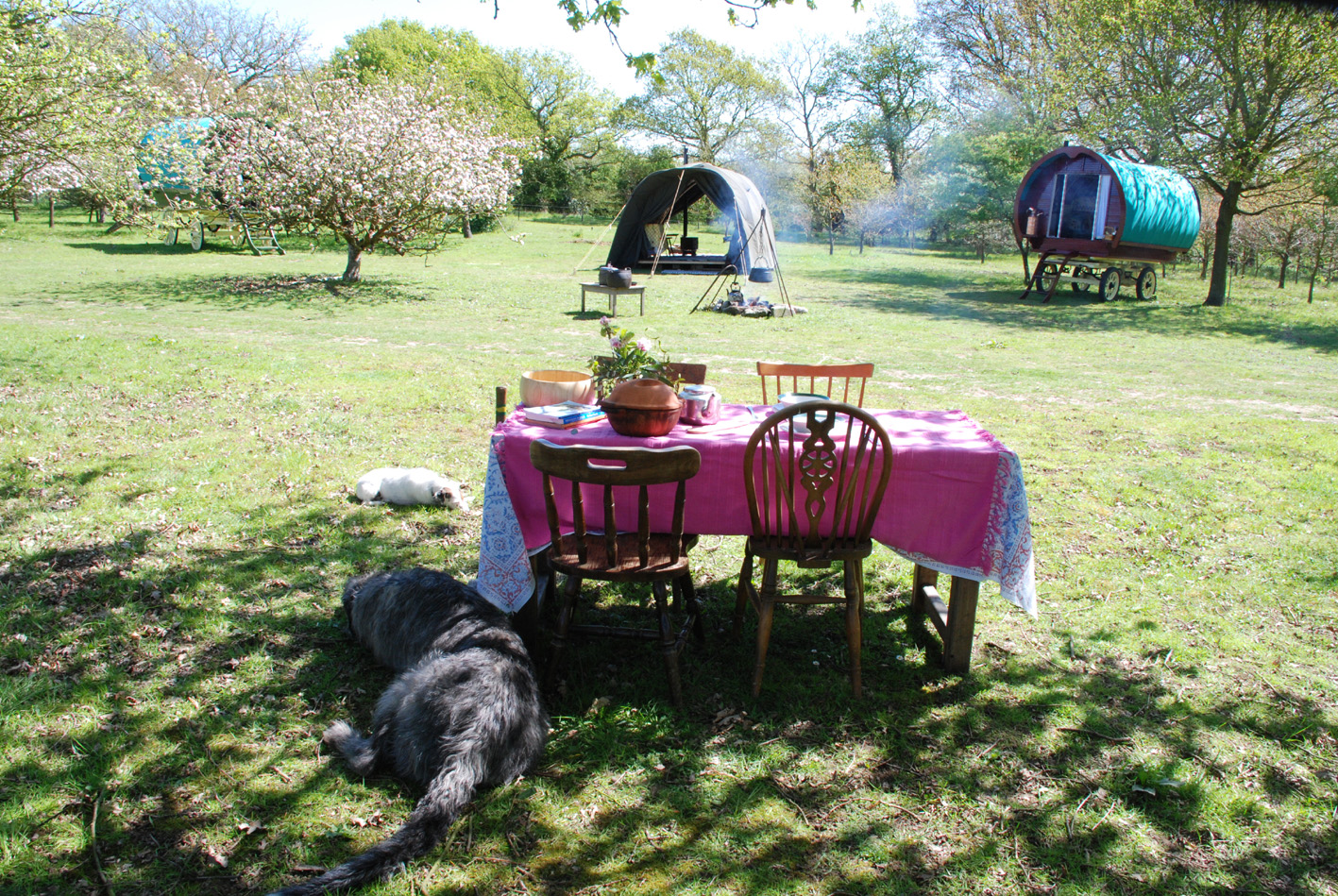
The Gypsy Camp , Essex – where two Romany bowtop caravans lie between the apple trees in a private orchard – is connected to central London by the National Cycle Network, so you can cycle all the way there from ‘town. Or, if you don’t fancy propelling yourself, you can catch the train and arrange for Ann, the owner and creator of this rural gem, to pick you up in her pony and trap from Wickham Bishops, a short bus ride from Witham Station.

Millstream Camp, Shropshire – To reach this hideaway under the stars, you can take the single track line to Bucknell, a rural station so tiny the train will only stop if you ask the driver.  Let Carolyn know and she can arrange to have two bicycles waiting for you on the platform. Then it’s just a three miles down quiet Shropshire country lanes to the Millstream Camp, where a homely shepherd hut just for two awaits you. You can even cool off after your journey with a dip in the dammed Millstream.

A stable by the shore at Lochhouses Photo: Canopy and Stars

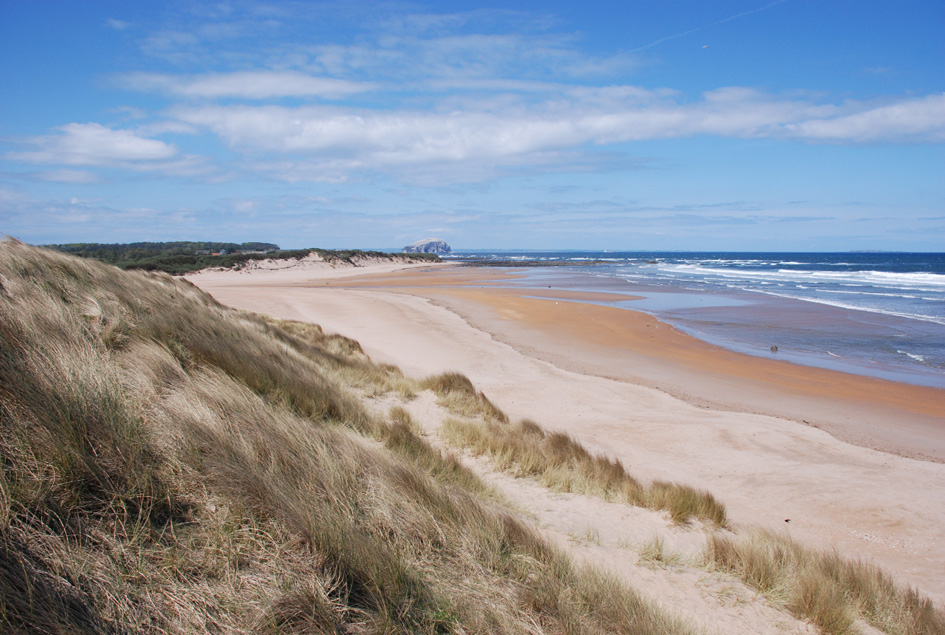
If you have access to a noble steed, you can gallop along the beach right up to the Lochhouses Safari Tents near Edinburgh, and stable your horse there, too! If you don’t have your own horse, don’t worry! Trains from Edinburgh Waverley to North Berwick take about half an hour, and there’s a trekking centre next door, so you can still go riding on the beach.

A ‘post bus’ sets off daily at 3pm from Llandovery, Dyfed (where the railway station is) and goes right to the bottom of the drive of The Cabin – a cosy octagonal space in the lush Cambrian mountains. If you can’t be bothered with all the stopping and starting as they pick up the post, you can always hire a mountain bike from the station (a very reasonable £3.50 a day) and cycle there.

The Mollycroft, a retired showman’s wagon, is less than a mile from the Coast to Coast walk, so an excellent place to stop off for a couple of days, and rest your weary legs.

You can reach On The Water, a luxurious boat in Regent’s Park, by bike (courtesy of Boris), horse (from Hyde Park stables) or canoe (hire from Pirate Castle). A stylish aquatic haven in the centre of London, On The Water is the perfect place to hide yourself away, or dip a toe in the city as you please.

Inshriach Yurt in The Cairngorms Photo: Canopy and Stars

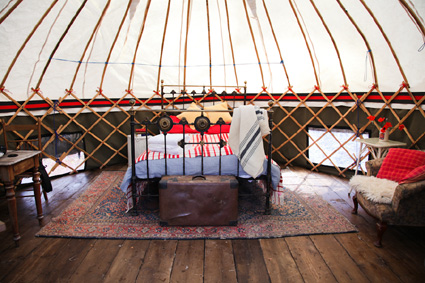
The Cairngorms are cool, especially when you discover them by canoe. You don’t even have to bother with much portage, with Inshriach Yurt, right on the water’s edge at. Take the train to Kingussie, and paddle all the way there in around three hours (with a guide from Spey Descents, if you don’t have your own canoe). Go down the Spey, through the Insh marshes and across Loch Insh. Enter Inshriach waters half a mile from Loch Insh and 2 miles later keep your eyes peeled for a yurt on your right hand side. Disembark for divine canopy, and of course, stars.

And if you really want to make an entrance, why not charter the Yacht Infanta to take you to By The Beach – a luxury yurt with a private beach on the Isle of Wight. Canopy & Stars has a wonderful collection of glamping places including a treehouse, luxury yurts, Gypsy caravans… even a boat in Regent’s Park!