Treeclimbing with Goodleaf, Isle of Wight

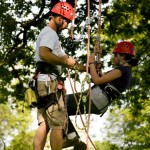
Paul McCathie teaching tree climbing. Photo: Creditableimages.com

(first published in the column, My Life in Travel, The Observer, 8 March 2009)

Interview with Paul McCathie, recreational tree climber, Goodleaf Tree Climbing Adventures, Isle of Wight

 I started climbing trees after a gap year travelling.  I came home to my native New Zealand in search of a ‘real job’, saw an advert for a tree surgery course, and went for that. Very quickly I realised that I liked climbing the trees a lot more than I liked cutting them down. That took me to Georgia in the US to train with Treeclimbers International, learning the techniques of recreational treeclimbing, and here I am. Climbing trees for a living, and sharing their virtues with other people is about as real a job as it gets in my book. .  


Most people think that treeclimbing is about high ropes courses, and corporate days out. But this is not our thing at Goodleaf. I work with only one tree, a sixty feet high ancient Oak. Over a period of two and a half hours I teach people how to use harnesses, carabiners, ropes and knots, as well as climbing and abseiling techniques. I also teach them a little about the history of the tree itself, and about tree conservation issues, before guiding them into its canopy at their own pace. They climb higher and higher as they gain confidence and strength. It is a personal, one to one, calm experience. The final abseil is down to a picnic rug laid out with well-deserved local goodies.


I love the Isle of Wight because it has the same laid back attitude and green outlook as back home in New Zealand. It has great beaches, fine woodland, and most importantly, my wife Abigail is an Islander. So lovely people, of course. When people visit the island, they leave some of their stresses behind on the mainland, which is a great way to start a holiday too. And an even better way for them to start a day of treeclimbing too.


If someone gets vertigo I talk to them a lot. There is usually a specific reason why they don’t like heights, so we can talk it through. They are harnessed and connected to the rope at all times, and I can reach them quickly and easily, talking all the time. The field we work in is very tranquil, so that helps calm people down too. Then I help them come down to a height they are comfortable with.


I turn from calm to cranky if people do not follow my instructions. I am not a control freak, but people need to be aware of the risks involved in tree climbing, and pay attention to all the details.


My hardest day as a treeclimber ended up being one of my best. I was working with a family whose young son had severe learning difficulties. He spent the first hour hiding under our picnic blanket, terrified to come out. One by one, I led his family members up the tree, and slowly but surely he peered out. Finally he donned his helmet and harness, pushed past his fear, and lifted himself up into the canopy. He absolutely loved it in the end. It was one of the most rewarding experiences I’ve had.


The best thing I have seen from the top of a climb is the vast array of indigenous trees which make up New Zealand’s Coromandel Forest. I spent half a day walking through this semi-tropical forest to find the right tree, a Kauri. This is a colossal tree, a conifer about 35 metres high. After scaling this beauty, I looked down into a valley filled with other Kauris, Kahikateas and other native species, all poking their heads through the lower canopy, the Coromandel coastline sparkling in the distance. 


A treeclimber’s five year plan is to ‘branch out’ (sorry). Ideally run Goodleaf on the Isle of Wight in summer, and head south to run Goodleaf New Zealand during the ‘winter’ months.


The best thing I’ve heard up a tree was “look at those Great Tits”. I wasn’t really allowed to laugh because one of our climbers really had spotted a nestful of them, with babies just learning to fly. Great quote though.


  • To book a treeclimbing session with Paul McCathie on the Isle of Wight, see his company’s website, www.goodleaf.co.uk. Climbing season starts 1st April 2009


Don’t wash your hands of Mexico

“You’re a bit of a fighter”, the Director of the Mexican Tourist Board, Manuel Diaz Cebrian told me at a recent conference. I had been asking too many pushy questions about responsible travel, as usual. He was quick to add, however, “We Mexicans like that, it’s good to challenge people”. The truth is, if anyone was a fighter it was him. Because marketing Mexico at the moment has to be one of the toughest jobs out there.

Tourism is hugely important to Mexico, and a health crisis of this scale takes its toll for years. Just think back to Foot and Mouth Disease. What did not help Mexico, however, was the confusion over travel advice in various parts of the world. Following the outbreak of the Influenza AH1N1 virus, The World Health Organisation (WHO) was not advocating travel restrictions. The EU told member states that it was up to each country how they handled the situation. The Irish and UK governments advised against all non-essential travel to Mexico, however many other countries rejected the notion of a total travel shutdown.

Manuel can breathe a sigh of relief now, as this travel restriction has been lifted here and in UK.  Extreme travel alerts can have a dramatically negative impact. An “all non-essential travel” restriction makes it very difficult to get travel insurance, for example. Ironically, there are now more cases in the US, but we don’t read about travel restrictions there. However, I am not suggesting complacency, and any responsible traveller should check out all health recommendations for travel to Mexico, or any other country affected by the virus at the Dept. of Foreign Affairs, www.dfa.ie.  

The media coverage of a destination, and its travel alerts, can have an equally negative impact on tourism.  It is worth researching the destination from all angles, read local blogs, and sometimes even question travel restrictions to countries you are keen to visit. Often they might focus on one city, such as Nairobi during the pre-election violence. Meanwhile the majority of this vast beautiful country was peaceful, and empty. Tourism is only starting to pick up there again, saved by their new hero, Barack Obama. But many destinations don’t have such wonderful ambassadors to put them back on the map again.


 It is interesting to note that any tourist still nervous about travelling to Ireland because of terrorism, and I have met a few, might not be reassured by the British Foreign and Commonwealth Office’ s (FCO) guidance, which says, “There is an underlying threat from terrorism.  Attacks could be indiscriminate, including in places frequented by expatriates and foreign travellers”. That is not what most Irish people would tell visitors, so I wonder what Mexicans would be telling us right now?


In 2003,
UK charity Tourism Concern (www.tourismconcern.org.uk) lobbied the FCO for a fairer and more transparent travel advisory system. This was driven by the blanket ban on ‘all non-essential travel’ to Indonesia, following the terrorist attack in 2002. In contrast, the USA also suffered tragically at the hands of terrorists the year before, but the travel advice was for ‘vigilance’, and a huge US tourism campaign immediately kicked in.  Indonesia’s ban continued into 2004, however, and the tourism industry was devastated as a result.  Tourism Concern’s lobbying worked, and now the FCO has an advisory committee in place which meets every three months to review its decisions, ensuring that destinations are not adversely affected by prolonged or geographically inaccurate travel advisories.


Luckily for Mexico, the restrictions have been lifted; tour operators are operating, and let’s hope the virus is contained. However, the impacts of the media coverage will hover for a long time. So, I am fighting alongside Manuel, and encouraging tourists to keep the doors well and truly open to Mexico, when planning future holidays. And if you want to avoid the crowds, then consider some of the responsible travel companies which take you well and truly off the beaten track, such as Explore, Exodus, The Adventure Company. For more information, see Manuel’s own www.visitmexico.com.


(First published in The Irish Times, 30 May 2009)


Wwoofers do it for free

Woofing sounds fantastically illicit, doesn’t it? The first time I came across it, I was staying at one of my favourite eco-friendly spots, The Omagh Hostel in County Tyrone.  The owner, Marella Fyffe, showed me to my room saying, “There are a couple of woofers in the next room, but they are very quiet”. I wondered if this was dubious Tyrone slang but, seeing my confusion, Marella quickly put me right. Woofing, actually spelt, ‘Wwoofing’, stands for World Wide Opportunities On Organic Farms. Just to confuse matters, it is also sometimes known as, “Willing Workers On Organic Farms”. Wwoofers are, therefore, the willing workers. Up until that point I had been a Wwoofing virgin, with no idea about all the fun I had been missing.


The Wwoofing system is quite brilliant in its simplicity, and is one of the finest examples of successful, practical and sustainable tourism. People of all ages, who are keen to travel the world, sign up with the international WWoof network, set up in UK in 1971, to see who in the world is looking for volunteers. These may be on an organic farm, vineyard, orchard, or even a restaurant with an organic kitchen garden. In exchange for four or five hours’ work a day, the Wwoofers get free accommodation and meals. For people like Marella, Wwoofers are an invaluable workforce.  But good hosts will always give back as good as they get which, in the Fyffe family’s case is great company, superb meals morning, noon and night, and the best local guides you could ask for.  


Wwoofing work varies from farm to farm, of course, and during my stay at The Omagh Hostel, Jurgen from Dusseldorf and Mary from Pennsylvania were planting seeds, transferring young beans to the polytunnel, watering the burgeoning young strawberry plants, stocking up the composter, and cutting the lawn in time to install a yurt for the Hostel’s summer party, raising money for a local conservation charity. 


As I helped place some organic lettuce seeds delicately into trays, we are all enthralled by Marella’s boundless energy and plans for total sustainability. That evening, Marella taught Jurgen how to knead bread, while I prepared a vat of salad using some of our freshly picked leaves. Did Wwoofers ever abuse the system, I wondered? “I have had Wwoofers for ten years now, and never had a bad experience”, Marella reassured me, saying, “You have to trust your instincts. You can usually tell from the first phone call if this is the sort of person you want to be sharing your time and home with”.  She went on to tell me that Wwoofers too can be exploited, being overworked and badly fed.  But she insisted that this is extremely rare, and the network is so tight, that such people would be exposed straight away.  


Wwoofing is not just for a student gap-year either. It is a great way to travel at any age, especially if you like the idea of travelling alone for a while, and often just a few weeks’ work is much appreciated by hosts, so you don’t have to give up a whole year. You just need to embrace the ethos of Wwoofing which is all about enjoying the old fashioned principles of non-monetary exchange of work for food and a bed for the night. It is also a short-cut route to breaking down cultural barriers, creating friendships, and it teaches the fundamentals of organics and caring for the environment. I hope the world is still Wwoofing when I have the opportunity to take-off in carefree mode, and make up for all that lost time, when Wwoofers were still one of the world’s best kept secrets.   


To stay at The Omagh Hostel, see www.omaghhostel.co.uk or Tel: 00-44-28-8224- 1973


To become a Wwoofer, see www.wwoof.org.uk or for similar work exchanges on anything from sailing boats to ranches, see www.helpexchange.net

This article was first published in The Irish Times, 16 May 2009


A self-guided cycling holiday in the Scottish Highlands

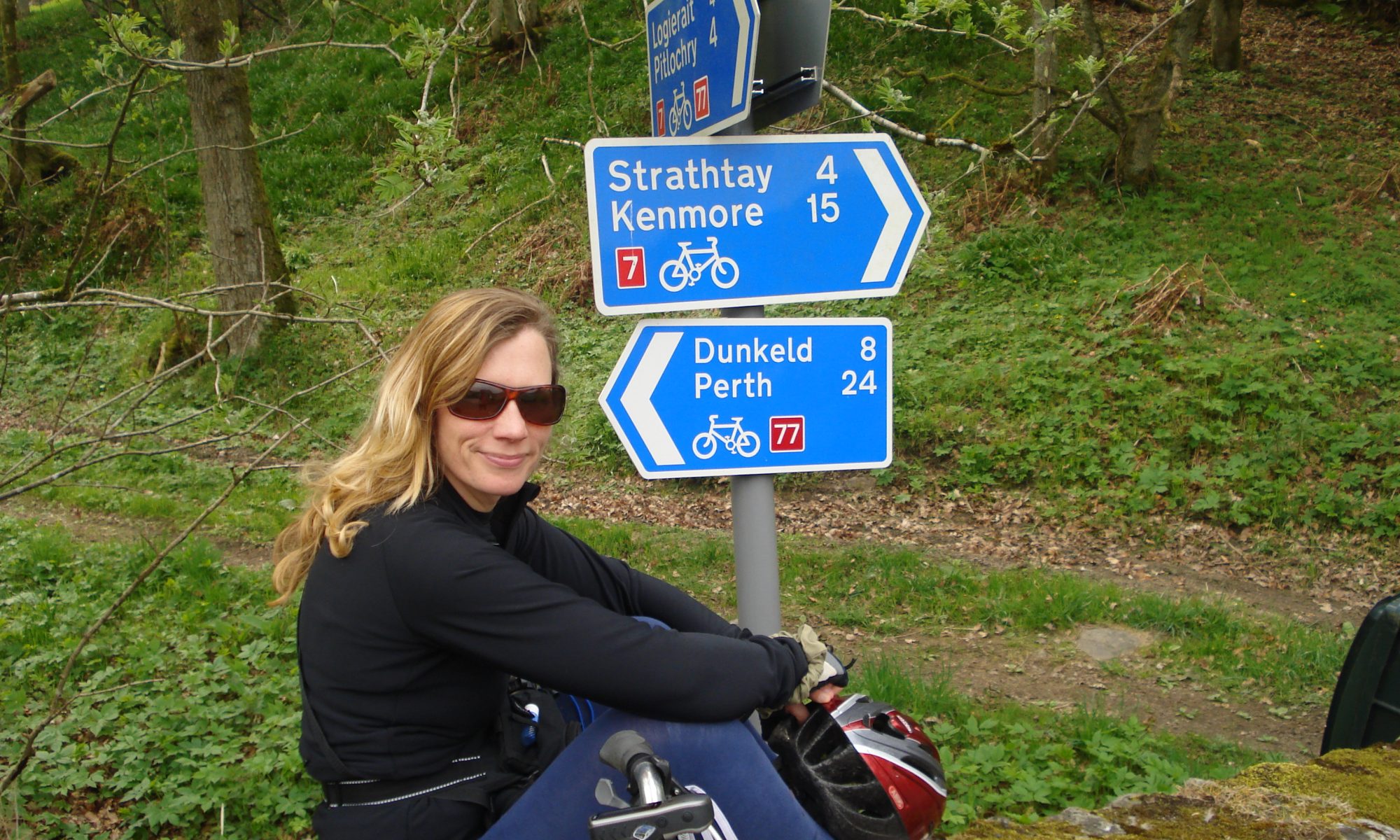
Cycling holiday in Scotland

“Think thin thoughts,” a man wearing only a t-shirt and boxers announces with a smile, as he squeezes past me and my friend, Laura, so close we get a minty waft of his freshly brushed teeth. It’s almost midnight, and I am standing in the corridor of the Caledonian Sleeper train, whizzing through English countryside, en route to Pitlochry for a cycling holiday in the Scottish Highlands. 

Continue reading “A self-guided cycling holiday in the Scottish Highlands”