This winter’s colours – Weaving holiday in Morocco

morocco1The dullness of British winter falls upon us, yet I am still fighting the urge to keep greys and blacks at the front of my wardrobe. I sometimes think I wear black as if in mourning for summer itself, and so a holiday which actually celebrates colour offered the perfect medicine to beat my SAD symptoms. It was a trip to work with Berber rug weavers on the Plains of Marrakech in Morocco. Gauguin once told his students “O, Painters who are looking for a colour technique look at rugs”. Personally, I was just hoping to weave my way out of winter misery.

This is a women-only holiday, as it is traditionally the women who weave in the Moroccan home. Not risqué enough to tackle Marrakech alone, it seemed ideal to travel with some fellow female adventurers, a small group never exceeding eight. Ingrid, the English textile designer who runs this trip, greeted us at Gatwick, with a smile as big as her enthusiasm for the journey we were all about to embark upon.

I had never done the ‘group’ thing before, and was relieved to find I had plenty in common with the others, particularly the two Americans who had travelled from Vermont to share this experience. One of them was Margot, an eighty year old wood-cut print artist, with long flowing white locks, and enough colourful stories from her worldwide travels to allay any concerns about group travel.

The first day was spent acclimatising inside the city walls of Marrakech’s Medina. It was pure theatre, where the actors seemed to enjoy the show as much as the spectators. I confess to having had preconceptions of seediness, and was relieved to discover a different world altogether than the one I had created in my head. Marrakech is a fun, warm place where everyone, orange vendors, artists and snake charmers alike, welcomed us with a smile, shared tea and stories, and giggled at, rather than mocked my ineffectual bartering techniques. Mohamed, our local guide was on hand at all times to help us shop, learn Arabic phrases, and get to grips with the local currency, Dirhams.

We started our weaving journey on day two, taking the 160 kilometres of dusty road across the Plains, known locally as Haouz, to the coastal town of Essaouira, our home for the rest of our stay. The landscape turned quickly from luscious olive and orange groves, to arid stony plains dotted with sheep. We stopped halfway at Sidi Mokhtar which, at first, resembled the rubble of a bombed-out village. This is Morocco’s weaving region, and home to thousands of people who survive on extremely basic means. It was also where we were going to learn to weave. The silence in the car signified a certain shock, as we took in the surrounding poverty. If Marrakech hadn’t taken us out of our comfort zone, here was the definitive wake-up call that this was going to be no ordinary holiday.

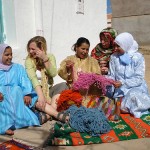
These villagers are settled nomads, from the Saharan tribe, Ait Bousbaa. There are signs everywhere of their rich weaving culture. Outside one building, a carpenter was building frames for hand looms, piles of wool sat in front of another, bright reds and oranges flashed through the doors of a small weaving factory. Finally, we went through some gates into an enclosed garden full of Bougainvillea, olive trees and herbs. We were welcomed by four smiling Moroccan women, our teachers, who offered open arms and copious kisses. This was the whitewashed, traditional Moroccan, and spacious home of Zinaib,morocco2 her daughter, Khadija, and fellow-weavers, Rabha and Hassna. The uproarious welcome echoed around the village, shattering any of our earlier discomfort. After copious amounts of mint tea, home-made bread, nuts and more hugs, we travelled on to our hotel on the coast, glad to have touched base with these wonderful women, before starting work proper.
The wind coming in off the Atlantic in Essaouira was a relief after the dusty drive. To my absolute joy, our new hotel was none other than the Hotel des Couleurs. It lived up to its name, each room themed from an eclectic palette of fuchsia, lime green, scarlet and lemon.

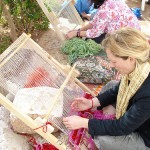
The next few days were spent back at Zinaib’s, learning every stage of the weaving process. First, the girls showed us how to spin wool on a hand-made wheel. I found it impossibly hard, and watched on, in awe, as they demonstrated what they described as banale, but which we found almost magical in its purety. Then we ‘warped up’ our weaving frames with cotton, and chose colours we wanted to work with from a sample selection, in preparation for the visit to the dyers the following day.

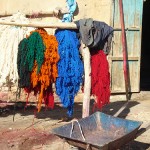
This nearby dyers was like the centre of a volcano, where sweating men poured red and purple dyes into bubbling stone vats. The blood-like piles of wool were then piled onto wheelbarrows and taken out to be spread on the rubble, to dry in the scorching sun. There is nothing natural or beautiful about this process. As I watched the stream of red chemicals flow out onto the streets, the men wiping their streaming eyes from the effects of this arduous chemical onslaught, my rose-tinted glasses were quickly tainted.

This was not a fast paced holiday, and I revelled in the time given to looking and learning before any loops or looms came our way. Evenings were spent back in Essaouira, which comes alive when the fishing boats come in. An array of blue wooden boats, all tightly moored together, cover the sea with a blanket of undulating indigo, with fishermen jumping from one to another to compare catches. It is a hub of excitement and commerce, and a joy to behold a fishing port doing real business. No surprise then, that I ordered fresh fish tagine on several of our nightly restaurant outings.
morocco32We spent the next three days in Zaineb’s garden, just weaving. And wittering. Then weaving again. Slowly pushing and pulling our brightly coloured wools through the cotton warp, and gradually trusting ourselves to let go of our gentle teachers’ hands.
The palette of colours we played with as we wove, was reflected in the colourful array of conversations which took place in the process. Travellers’ tales, political debate, cultural exploration and family stories. No hints of the ‘knitting circle’ trivia I had feared, when teased by friends back home when they heard what I was doing.

The Moroccan girls told us how much they enjoyed this cultural exchange, as well as the extra income. They are paid well above their normal weaving wages for training us, and the amount of laughter in the house confirmed their obvious willingness to participate in this tourist venture. Ingrid is a firm believer in sustaining the local economy through tourism. As well as providing income to the weavers, she uses locally-owned accommodation, family-owned restaurants, and of course, the services of Mohamed, our invaluable and charming local guide. One visitor was a little unhappy with the budget-style accommodation, and lack of ensuite facilities, considering the price of the package. However, when I priced the rooms, added flights, meals, and salaries, I concluded the cost to be reasonable. If you don’t mind eating out of the same giant family couscous bowl at lunchtime, then you won’t mind sharing a bathroom.

You can’t put a price on spending quality time with women from a completely different culture. We swapped skills, were dressed up in Saharan jellabahs, had our feet painted with henna, and our eyes with kohl. And we all, Moroccan, European, and American, laughed a lot. On my last day, I cut my work away from its warp strings and held the mere two feet square of reds, oranges and pinks close up to my face, as if to inhale all the goodness from this priceless experience. But you can’t bottle something like this. You just have to experience it.

Catherine travelled with Ingrid Wagner Real Life Journeys. See www.ingridwagner.com for details. Eight day weaving holiday £925 including flights. Other Real World Journeys include cookery, painting and culture tasters.
Catherine flew with Easyjet from Gatwick to Marrakech. Flights from £29.99 one way.

(This article was first published in The Observer 25 January 2009). For more photos of this trip, click here.
Wetsuits on the westside

hugo-connemara_opt“Oh God, it’s surfing today”, I mumbled, looking at my detailed spreadsheet of activities and then out the window, at the incoming Connemara fog and rain. It’s Day Four of a week at Delphi Mountain Resort, nestled in the hills between Killary Harbour in Leenane and Doo Lough on the road to Louisburgh. We have come for a week’s family holiday, and in three days have already been high rope climbing, mountain biking, learned archery and climbed a sixty foot wall. It is a long time since I have been so active on holiday, but it works, because I can’t ever remember being this chilled, bar student holidays in Ibiza, and that’s too long ago to be a reality anyway. However, Day Four is my first ‘wetsuit’ day, and suddenly this hiking-biking-chilling Mum has turned chicken.
 

I send the family off to the restaurant for breakfast, while I mull things over a bit from the comfort of my bed, lapping up every bit of the room’s four-star qualities, the main feature of which is the word ‘suite’. I like that word. I can do ‘suites’, especially with two loud boys sleeping downstairs in a room which is bigger than our home, their own bathroom, and a lounge full of  sofas to bounce, wrestle, and collapse on.


So far, we have done everything here as a family. Day One we met our instructor Sean, who guided us all up the sixty feet climbing wall. Originally from Ballyfermot, Sean is now a devout worshipper of the “Real West Sa-eeed”, as he showed some complicated ‘W’ sign to the boys with his fingers, in a surf dude bonding way that they seemed to get the hang of immediately. After explaining harnesses, carabiner clips, and safety tips (like don’t let go of your partner’s rope when they are hanging on to it thirty feet above your head) he gently directed us up the wall. The boys were boringly predictable in their monkey-like agility, and I equally predictable in my awkwardness, leading ever so non-gracefully to a fit of vertigo about halfway up. Legs turning to jelly, cold sweat breaking out, my children (one of them already about ten feet above me) shouted encouraging words. Sean calmly gave directions to me and my husband, the latter being connected to me by rope. He successfully obeyed that lesser known marriage vow, “Whatever you do, keep it taut!”.  I got through the crisis moment and kept climbing, to the cheers of my family, finally absailing back down with an elated grin as if I had just conquered Everest. And yes, we did have a big family hug when I got back down. It was our Disney family moment, quickly shattered by Sean, however, who had us straight back up there again. Rock hard these Westsiders.


Doing all these things together, with the instructor riding a fine line between activity expert and family mediator, was genuinely fun. Not in a family reality TV show sort of a way, but just plain simple fun. . I wouldn’t have dreamed of going into a wet forest in August, to don raingear, headgear (to protect you from midgies) all in the name of playing Robin Hood with my children. However, give me a young energetic archery instructor, with more enthusiasm, patience and sense of fun than I have in my little finger, and suddenly I am perfect parent personified. I decided archery might even be my thing, and might look out a club when I get home. ‘Cause that’s going to happen.


I am still mulling all this over from the warmth of my crispy white duvet, when the reality of wetsuits, surfboards, Atlantic waves and rain kicks in once again, and I shiver at the very thought.. Just then, the boys bound back delphi-mountain-resort-6_opt1with a ‘stolen’ breakfast from the dining room (superb buffet of healthy cheeses, mueslis and yoghurts for the German wannabees, or Germans, and fried everything for us Paddies. Or wannabees. Bet the Muesli munchers don’t have wetsuit worries, I thought, as I scoffed on a couple of fine Connemara sausages. Then comes the best news:  surfing’s off this morning. Not due to lack of interest, of course, they don’t do that at Delphi. Just due to bad weather. But they hope to make it out this afternoon. I feign disappointment, thank the Delphi gods, and down a bacon sandwich.
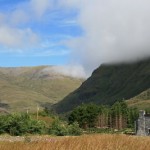
 

We end up spending the morning in the upstairs lounge of this stunning stone and wooden building, which has been recently restored (and saved from receivership) by Aileen and Rory Concannon. They have put every ounce of passion into this place and have pulled it off, bigtime. They joined us for coffee, chat and a round of Trivial Pursuit, checking in with all their other guests, most of whom had also put activities on hold. None of them looked too fed up about it. Indeed it is hard to be fed up in this lounge, with its view over the misty Delphi Valley, its endless waterfalls tumbling down the mountainsides. It is an ever-changing landscape of picture postcard Mayo .Having the whole morning just to lie back on sofas, play games, and watch the clouds go by, is just as much part of the scene at Delphi as climbing that same mountain when the mists have moved on. You don’t have to ‘go go go’ round the clock here at all. Noone checks how many miles you have covered, calories you have spent, or how many family bonding activities you have done. You can come here and do absolutely nothing. In fact, they positively encourage it.
 

For an outdoor activity centre, Delphi still manages to exude tranquillity from every pore. Rory and Aileen pride themselves on the fact that the best things here are free. It is mobile-free, protected from signals by the mountains which enfold it, bedrooms are television-free (the kids got over that in 24 hours), activities motor-free, and the heating and hot water is carbon free. With two state-of -the-art wood burning boilers, the carbon emissions are neutralised by the replanting and sustainable management of their own 300 acres of forest.  Even the water is free, sourced from the local mountain spring.  If you travel by train, they meet you at the station, with free use of bikes when you get to Delphi.


The food is not free, however, and although a little pricey, it is worth every penny. You can eat Lobster Thermadore in the restaurant, or fish and chips in the bar, all freshly prepared by the same chef Gerard Reidy, who is a staunch supporter of the Slowfood movement, and ensures that everything is local, seasonal and organic when possible. It was also delicious, filling and child-friendly, ticking all necessary boxes. Half portions of main dishes were prepared for the children, none of your chicken nuggets and chips while you tuck into crab linguine.


What I love about Delphi Mountain Resort, is it’s down to earthness. It is four star without being uptight about it. They can’t be, when they are dealing with endless muddy boots, over-excited children, workaholics who are panicking because they have ‘no signal’ and telly addicts who are panicking because they have nothing to put their kids in front of. They deal with it all calmly, with military-like precision considering the logistics of everyone’s itineraries, and with a warm Connemara welcome which is a slap in the face to cynics who say that this no longer exists in Ireland. Those on tighter budgets can opt for dormitory-style rooms, with basic bunks and bathroom, and still avail of the top breakfast, lounge facilities and all the rest. You can’t tell a ‘suite’ person from a ‘bunk’ person once you’re halfway up a climbing wall, or diving off a pier anyway. Or as Rory says, “everyone is welcome to the party.  Whether you’re in the surf or on the sofa, it’s just all about chilling here”.


But Disney always has to have a happy ending. The credits roll, the mists lift, she dons her wetsuit, strolls bravely down the Connemara strand hand in hand with her sons, and dives straight in to the Atlantic waves. No icy pain, just fresh Celtic chills engulfing her as she watches both her children jump up on their boards first time, hands out like something from Baywatch. Oh to be eight again. Sean, our surfing instructor today, and newly adopted hero by our children, cheers them on, guiding them safely into shore.  In reality, I hadn’t a hope in hell of getting up on my board, and knew when I was beat. But I kept trying, falling, laughing, and when eventually, the shivers set in, I marched proudly up that beach, a veritable wetsuit convert. “Can we go again tomorrow morning, Mum?” the boys asked in unison, “Pleeeese”. ‘Sure’ I replied confidently, knowing that I was booked delphi-123_optin for a morning’s seaweed bath, massage and hydrotherapy session in their state of the art spa. You don’t have to do everything as a family, after all. That’s just in the movies, and you can give me Delphi over Disney any day.

 

 Prices from €40-€300 per night including breakfast. See their website for special offers, including Spring mid-week and weekend breaks from €99 per person per night, including luxury double room, breakfast and half day activity. 

For more information see www.delphimountainresort.com , Tel, +353 (0) 95 42208.

(This article was first published in The Irish Times, 24 January 2009) 


Plane speaking – Heathrow expansion

Environmentalists have been fighting economists over the decision to expand this already vast airport, which handles more international passengers than any other, to the bitter end. The decision was finally made, last week, by the British government to go for it and build a third runway.

The big “compensation” is that the new runway will be – get this – green. All new slots will be “green slots” for use only by the cleanest aircraft. How considerate to offer us a runway that cares about the world. What a great motivation that will give airlines to do their bit and reduce emissions. The carbon crims can just head over to the other runways to take off at leisure. As for helping the rest of public transport, there will, apparently, be moves to improve Britain’s high-speed rail links. Guess which ones? The ones destined for Heathrow, of course. Hurrah for progress.

Thankfully, some airlines are working to improve their emissions technology. One excellent website for those of us who have to fly sometimes, but who want to do so more responsibly, is www.flysmart.org. It provides some good tips, the top one being, ironically, “take a train when possible”. A “smart flyer” can travel more carbon efficiently by going direct, taking minimum baggage and choosing a carbon-efficient airline. Unless you are a green plane spotter this is tricky, so the site provides a link to a carbon-friendly flight finder. This ingenious use of internet technology allows you to find your cheapest flight to a destination not only moneywise but also carbonwise. Doing a random search on a flight from Dublin to New York, it was reassuring to see Aer Lingus come out the cheapest and greenest. Even smarter, you can then go straight to the booking section and buy your flight.

According to Fly Smart, we should also consider options other than offsetting the carbon emitted by our flight. I agree that the technology (and transparency) of offsetting companies is still overwhelmingly complex, and planting trees or building a solar panel means nothing to many people.

I am all for contributing to much-needed renewable- energy schemes in any way we can, but contributing to the conservation of a country you visit, for example, is equally important. I highly recommend a system put in place by Friends of Conservation, which works in destinations around the world to support not only wildlife causes but also the communities whose lives are inextricably entwined with the wildlife and habitats the group works to protect. On its website, www.foc-uk.com, enter details of where you plan to visit and it will calculate a donation that you can then allocate to a project of your choice. There is no complicated carbon calculator, just a fixed amount based on average carbon emissions for the journey you are making. This is a superb way of raising funds, creating awareness of the group’s work and making us think about our impact on the destinations we visit. Friends of Conservation urgently needs money for water projects in Uganda, rhino protection in Tanzania and other causes.

It is hard to stay focused on the carbon debate as we watch how leading politicians deal with situations such as the Heathrow debacle. If they aren’t bothering, then why should we? But as I rapidly lose faith in the big decision makers in this fragile world, where money still drives just about everything, I am being led by the famous words of a somewhat more inspirational leader, Mahatma Gandhi, who said: “Be the change you want to see in this world.” Now he was smart.

(This article was first published 24 January 2009, in The Irish Times)airport

La Rosa Hotel, Whitby

la-rosa1Everytime I come to Whitby it’s enshrouded in mist. It’s as if it wants to keep some of its seaside secrets safe from the rest of the world. Just in case we might arrive with notions of wanting to change it. Luckily, the owners of recently opened La Rosa Hotel have no intentions of trying to change their rightly beloved Whitby. They have just added to it with a unique style and sense of fun that befits the town which it overlooks, from its Victorian cliff top terrace.


The Hotel is the latest venture of the owners of nearby La Rosa campsite. Here, a selection of glorious vintage caravans are decorated with treasures emanating from years of bric-a-brac hunting. It seems apt, therefore, that such lovers of playful kitsch would choose the former favourite hangout of Lewis Carroll as their new place to host guests.  Just like his most famous story, La Rosa an inviting, fun and seductive wonderland.


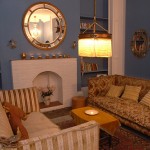
First stop the tea room, with one large wooden table to sample the ‘Mad Hatter’s’ tea. Antique red velvet curtains, a ship’s piano, eclectic paintings, silver cake forks, a séance lamp and china tea sets are just a few of its many curiosities.  Centre stage is a huge wall hanging from an old shooting gallery, saying “Our true intent is all for your delight”. No truer words.


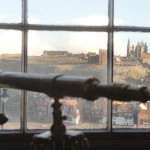
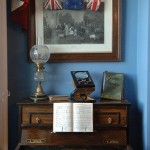
I stayed in the Lewis room, the only one specifically dedicated to their most famous resident. Whitby’s other claim to fame is Dracula, so the Stoker room is also a must. I lay back on the antique brass bed, covered with black and gold eiderdowns, and took in the seascape through the two large windows. Virtually unchanged since its Victorian heyday, the waves pound at the clifftops, with the Abbey ruins perched up above, la-rosa3providing the ideal setting for La Rosa’s sense of theatre. An old writing desk, stack of battered suitcases, telescope, game of solitaire, and a display cabinet full of Carroll’s own possessions,  the perfect props.
 

All the bathrooms have Wonderland chess-set black and white tiled floors, Victorian roll-top baths and mirrors galore. There was no shower but then this was not a ‘get-in, get-out’ sort of bathroom. Warm and rich in its décor, I luxuriated and lingered in natural rose and lavender bubbles for as long as I could.


La Rosa is not, however, a theme hotel for Alice wannabees. It is simply a magical melange where every painting, lamp, bedspread, rug, and teacup has been sought out, restored and adored. Individuality is what La Rosa is all about. With only eight rooms (and an apartment sleeping six), they take pride in meeting individual needs. Instead of tellies, you can request a ‘media hamper’ with ipod, dvd player and a selection of movies or music. Breakfast is delivered in a hamper to your room, with the most delightful collection of treats. Nuts, honey and yoghurt, served in a china cup, a cheeseplate, orange slices, and pink candystripe bags full of grapes and fresh bread rolls.


The love of hospitality oozes from every rescued piece of gorgeousness at La Rosa. I took an evening walk la-rosa4around the town, stopping for superb smoked Whitby haddock at award-winning bistro, Green’s. However, I found that the magical, almost childlike charm of La Rosa quickly enticed me back up the clifftop steps, guided by its red fairylight illuminations blowing in the wind. It was like being welcomed back into the unquestioning arms of a mother with a great big story book, full of surprises and delight.


La Rosa Hotel, Whitby, North Yorkshire

01947 606981

larosa.co.uk


Cost: Double room with balcony, seaview and breakfast £85 per night. Private hire of whole hotel including tapas dinner, £45 per head (for 22 people)


Getting there: National Express East Coast train to
York and bus to Whitby, (all included in National Express train ticket price). From £16 single. nationalexpresseastcoast.com


(This article was first published in The Observer, 11 January 2009)